

JHinkle wrote:If so - what is the bus rate most operate at? Are there any at 250Kbps? Is there a need or a want for that level of performance?
I believe they all operate at the official standard 250kbps when in DMX mode.
Following the timing spec (including long space and mark between packet), this give you a maximum update rate of 44hz, with 512 channels (one universe).
Some people sequence with 25ms timeslots; that's a 40 Hz update rate. DMX at the standard 250Kbps can handle that. Renard at 115.2K and more protocol overhead could not handle as many channels at that rate.
If you need more than 512 channels, you use multiple universes (different RS485 busses, operating in parallel). Or e1.31 which is multiple DMX universes over ethernet. (Currently, e1.31 is usually broken out into multiple standard DMX512 RS485 universes for connection to DMX controllers - eg: ECG-DR4; or used directly to drive i2C or manchester smart pixel strings using DMX universes which exist only in software, never hitting RS485 - eg: e680).

Zeph wrote:Some people sequence with 25ms timeslots; that's a 40 Hz update rate. DMX at the standard 250Kbps can handle that. Renard at 115.2K and more protocol overhead could not handle as many channels at that rate.
To clarify - yes - this is with 512 channels - however Renard only sends as many channels as you have so it can do 25mS timeslots just fine - albeit with less channels. There's a table that shows channels/baudrate that are safe to run : 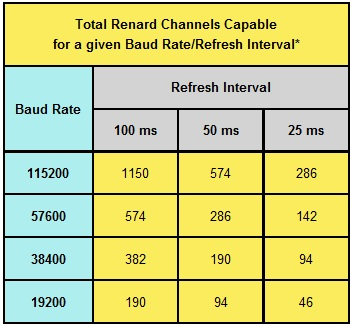
I'm clarifying because some folks may get the idea you can't do 25mS at all with Renard which is not the case.

Zeph:
OK, I think I get it.
One can still use a standard DMX protocol but the "new controller" can have a lookup table with 8 or more bits in the table. Only 256 table entries can be accessed if using the DMX 256 bits dimming, while the table output implements the higher resolution dimming curve.
I've seen that technique used before in some audio stuff of the 80's - if memory serves me right. 🙂

budude wrote:I'm clarifying because some folks may get the idea you can't do 25mS at all with Renard which is not the case.
If you don't mind tinkering with the protocol (adjusting the firmware and the plug-in), you can also get significantly more channels than that if you drop out null channels. It depends somewhat on your style of sequencing, but for the displays I've watched many/most of the channels are off at any given point in time. If you don't bother sending those down the wire, there's a lot less data.
don

Many different kinds of DMX devices will use multiple channels to provide enough information to the device for it to do it's function. Moving lights, for example, use multiple DMX channels to specify position in two axis, color of light, iris control, and special effects. There are even sub-modes for some devices that allow more precise movement commands and the like. So using two channels to get a 16-bit value is not out of the question if it's needed. That's in commercial lighting, but the principle is the same, especially since you are considering writing a custom plug-in for Vixen.