

P. Short wrote:Sorry, a scope trace by itself doesn't mean diddly. It's much, much better than talk without any observations at all, but it is just a starting point. I haven't seen any explanation with numbers that supports the observations, including why the transients are present and why they are as big (or small) as they are observed to be. This would need to take into account the characteristics of the SSR, the cabling and the LED string. Without these I consider this to be just hand-waving.
Perhaps - but there were numerous posts of folks saying it fixed their issues completely. Now - was it due to the phenomena explained by chuckd - maybe/maybe not - but it sure seemed to work in many cases. To be fair - it didn't work at all in some cases but again, it's a simple enough experiment/addition to your setup (like - maybe $1 of stuff...) to try it...

Reddy_Kilowatt wrote:Just a guess-I still only have a handful of LED strings in my display and haven't dissected any of the green blobs. The LED string manufacturer needs to drop the 120V RMS voltage down to a manageable level in the cheapest way possible. One way, might be using a transformerless power supply such as below and could be why the strings look like a capacitive load.
http://www.aaroncake.net/circuits/supply5.asp-Craig
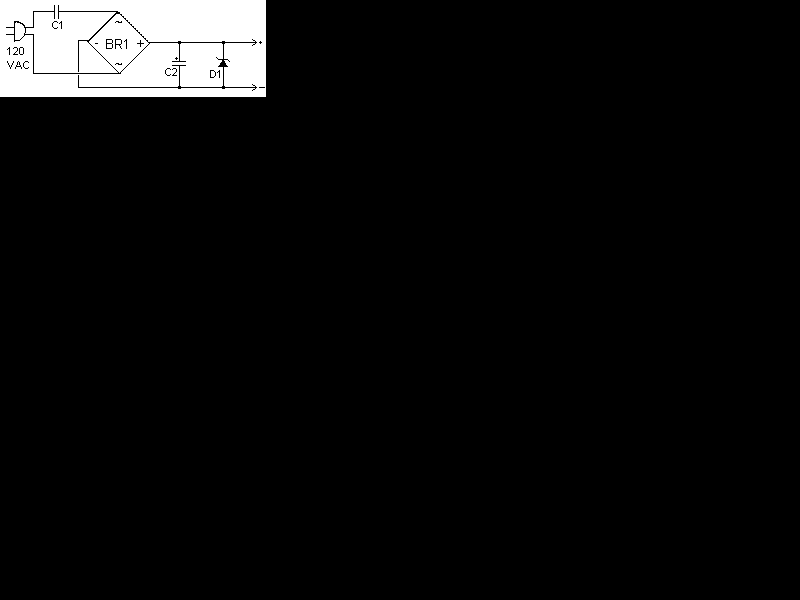
even at that instant that would be nice...alot of my LED light strings dont have anything(i know half wave) but they use nothing of the sort of diodes capacitors or resistors in any form series, parallel, bridge, etc....

Entropy wrote:The problem with LED strands is that they are simply a far lower load than most SSRs expect, and a fairly nonlinear one, however not one that is significantly inductive or capacity. Since they have far lower load, it is easier for line noise and transients to false-trigger the triacs. Adding some constant nice linear load solves this problem.
That was the explanation I was given by a couple of electronics geniuses that I work with.
Just my 2 cents...
Andy
"Adding some constant nice linear load solves this problem."
so if this is the case what would this consist of ?

griffixdc wrote:"Adding some constant nice linear load solves this problem."so if this is the case what would this consist of ?
A parallel resistor.