

ErnieHorning wrote:All diodes have capacitance. Twisting to wires together also has capacitance. Testing showed that adding LED strings together would increase the capacitance and a string that was modified to be an extension cord and twisted, did not increase the capacitance.
Adding a resistor in parallel, is not a snubber but that's what it's being called though in this case, it has the same effect.The added capacitance, phase shifts the current passing through the TRIAC with respect to the voltage. This seem to keep the TRIAC conducting. The resistor is the cheapest universal fix that appears to work most of the time though the success varies with the string construction.
I think the problem would go away if the output was a FET transistor instead but a TRIAC is more robust to abuse.
i am glad you aren't the only one that thought a flaw could be in the triac 🙂 ....another analogy of what we call is a "snubber" which really isn't a snubber because snubbers were created to smooth out voltages not get rid of them but anyways take a 1 farad capacitor used for a car....in that kit they give a resistor and small light if you want to drain the capacitor with out using it you hook this resistor and light on the positive probe and connect it to the negative then MAGICALLY the capacitor is drained and has no danger potential and no power stored. (although some kits only come with a resistor) luckily we are not dealing with 1 farad of capacitance otherwise it would take about 2 mins to drain it every time it got recharged.
another method of discharging it would to be to use some arch probe device.(something the short the 2 ends together without the line voltage applied to absorb the charge) although this method is not a very good solution because it would be very temperary and would degrade after each time it had to absorb the voltage

griffixdc wrote:i am glad you aren't the only one that thought a flaw could be in the triac
I'm not saying that there is anything wrong with the TRIAC, it works the way it was designed to. The issue is when voltage and current get out of alignment with each other. Yes, it really does happen.
If your interested - http://www.pcguide.com/ref/power/ext/basicsPower-c.html
ErnieHorning wrote:I'm not saying that there is anything wrong with the TRIAC, it works the way it was designed to. The issue is when voltage and current get out of alignment with each other. Yes, it really does happen.If your interested - http://www.pcguide.com/ref/power/ext/basicsPower-c.html
im sorry i wasn't trying to say there was anything wrong with the traic...i am just saying its the flaw of the triac

Sorry, a scope trace by itself doesn't mean diddly. It's much, much better than talk without any observations at all, but it is just a starting point. I haven't seen any explanation with numbers that supports the observations, including why the transients are present and why they are as big (or small) as they are observed to be. This would need to take into account the characteristics of the SSR, the cabling and the LED string. Without these I consider this to be just hand-waving.

Just a guess-
I still only have a handful of LED strings in my display and haven't dissected any of the green blobs. The LED string manufacturer needs to drop the 120V RMS voltage down to a manageable level in the cheapest way possible. One way, might be using a transformerless power supply such as below and could be why the strings look like a capacitive load.
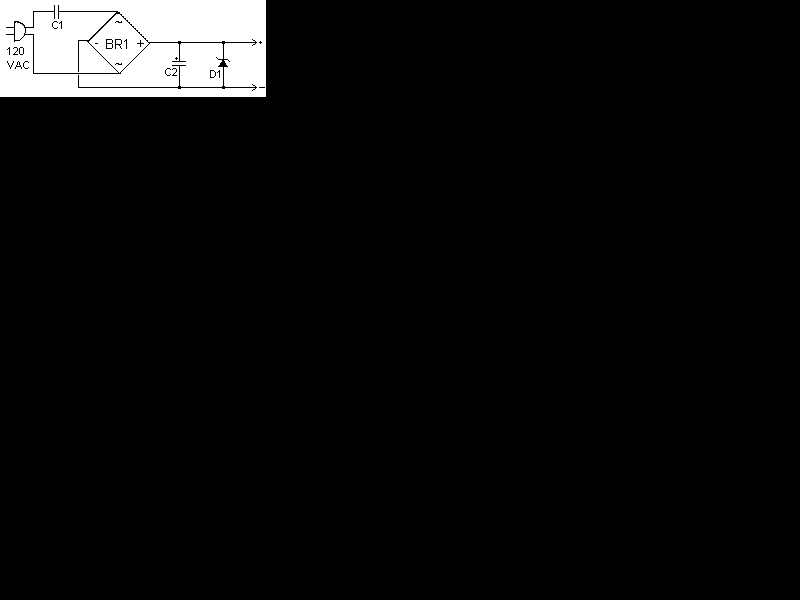
http://www.aaroncake.net/circuits/supply5.asp
-Craig
