

The most common way to combat effects of cable capacitance (and other issues) and improve signal quality is to use null pixel.
That means you have to make sure you add all those null pixels to your sequence.
The better solution I think would be to create a small buffer/line driver board which could be used instead of null pixel. The good thing about it is that it will work with any pixel protocol, will be transparent to the sequence, and will work with any voltage.
If we do GB, the price of such driver would be ~$1.50 or less.

I would take some. This is a much better solution than working with null pixels.

RobG wrote:The most common way to combat effects of cable capacitance (and other issues) and improve signal quality is to use null pixel.
That means you have to make sure you add all those null pixels to your sequence.
The better solution I think would be to create a small buffer/line driver board which could be used instead of null pixel. The good thing about it is that it will work with any pixel protocol, will be transparent to the sequence, and will work with any voltage.
If we do GB, the price of such driver would be ~$1.50 or less.
I'd be in for 10. How does it work?

I would take some too I've not needed any yet but would buy some just to have on hand.
Chris
Holiday Lighting, LLC
Your Source for Genuine Mean Well Power Supplies
https://holiday.lighting
 https://facebook.com/holidaylightingllc
 @holidaylightin9

I'd be in for 10
Nice to see such a quick response 🙂
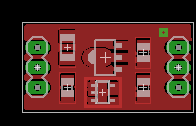
Now, the question is, should we make it SMT like on the image or through hole (TH would be 2x or 3x larger.)
tucsonlights wrote:I'd be in for 10. How does it work?
You plug it inline just like null pixel.

RobG wrote:Nice to see such a quick response 🙂Now, the question is, should we make it SMT like on the image or through hole (TH would be 2x or 3x larger.)
You plug it inline just like null pixel.
I like through the hole...what would be the dimensions of both?
budude wrote:Not sure if you've seen THIS? (uAmp)
No I haven't, but it's pretty much the same functionality.
The dimensions will be:
SMT 0.9" x 0.45"
TH 1.25" x 0.5"

I'm assuming that the board is assembled two ways, one with a transmitter chip and one with a receiver? A five-pin chip doesn't have enough pins to have a direction-control pin.