

P. Short wrote:I'm not clear about what you are thinking.Forgetting about the timer for the moment, are you planning on using one DPST relay for each channel? And specifically how are you planning on creating the signal to switch the relay between the static and dynamic modes? Is that signal going to be a dedicate vixen/Renard channel, or what?
And I'm also unclear on what your problem with the timer is. If you are using a standard 24-hour timer from a hardware store, why can't you just leave it running all of the time? Do they really stop running if their output load is disconnected?
More explanation:
The signal that gives data to the boards has a voltage ...that voltage i was going to use to be the control side of the relay...being that the relay is Normally Closed when that signal is lost(the display is over) it will trigger the 120v power that will controll the time clock which in hand controls the static lights.
The Problem:
If this time clock is only recieving power when the display is off, then the timing it per real time is out of question because its not possible....unless....the timer has two sources of power. 1) to keep the clock functioning without loss of power and 2) the power that is going to get switched by the timer to in the end control the static lights.
This method will ensure the most accurate transition from( static on - display - static again -static off)
what i like about ErnieHorning solution is that you can ramp up the lights and choose the brightness other than that id rather use the computer system separate from the static control.
To answer you question...i will probably only use 1 or maybe 2 DPST relays depending on the load of the static display (these relays have nothing to do with channels of the boards)
EDIT: i might be having the wrong idea by having such a low voltage control the coil of the relay to switch such a high voltage...i am not finding such relay which then means i will need a transformer to up the voltage from one relay to another one to control the 120v power.

griffixdc wrote:i might be having the wrong idea by having such a low voltage control the coil of the relay to switch such a high voltage...i am not finding such relay which then means i will need a transformer to up the voltage from one relay to another one to control the 120v power.
Specificaly, what (coil volatge, AC/DC, output current) are you looking for?
ErnieHorning wrote:Specificaly, what (coil volatge, AC/DC, output current) are you looking for?
well 5v dc coil voltage to switch 120v 15 or 20 amp ac

I don't see how having one or two relays is going to allow you to switch between a static and dynamic display. You could use one or two relays to switch the entire display on/off, but I think that you would need one relay (or one set of contacts) per channel to switch between static and dynamic.
I was also assuming that the static lights were the same lights as the dynamic lights...that the show lights would all be on (or mostly all be on) during the static part of the show. If the lights are the static part are completely different from the show lights, then ignore my previous comment.
P. Short wrote:I don't see how having one or two relays is going to allow you to switch between a static and dynamic display. You could use one or two relays to switch the entire display on/off, but I think that you would need one relay (or one set of contacts) per channel to switch between static and dynamic.
i am not saying your wrong...i am just trying hard to understand what you mean.
If the computer controlled display is off due to vixen timer or vixen scheduler why would i need relays to turn off the channels to go to static?
EDIT:just got your last message so i will ignore 🙂 🙂
griffixdc wrote:well 5v dc coil voltage to switch 120v 15 or 20 amp ac
In that case, why not just use and SSR block like this?
ErnieHorning wrote:In that case, why not just use and SSR block like this?
oo good find! so i am assuming since its not listed its a NO (normally open) ssr so i would get a relay with a 120v coil and a 120v switch or am i thinking this wrong?
Originally i listed i needed a DPST relay only for the flexibility to be both NO or NC but i only need to salvage the NC contacts
This being a do it yourself site, here is a relay delay timer meant for shutting an appliance off after some time.
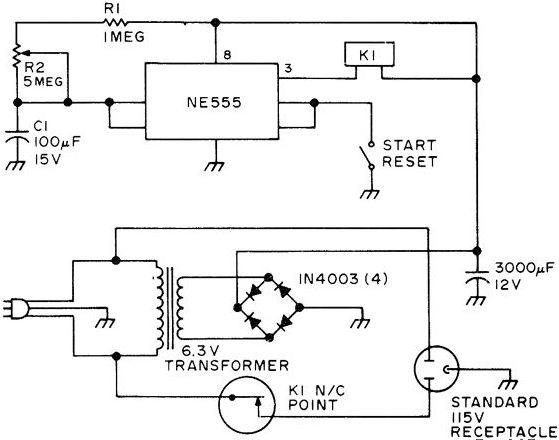
NE555 timer circuit turns off television set or other device at any desired time up to about 1 h after start switch is closed. Use IRC MR312C relay having coil resistance of 212 ohms, or other 12-V relay drawing less than 200 mA. With values shown, R2 gives time delay range of 3 to 58 min. For other ranges, change values of R2 and C1. Clockwise from top, pins on NE555 are 8,3, 4, 2, 1, 7, and 6.
It looks like you’d have approximately 1 hour if R1 was set to max though you would get a finer resolution if you reversed the values of R1 and R2.
The switch resets the timer each time it’s closed. If you replaced that switch with the circuit used for zero cross detection from a Renard controller outputting to a series diode with a capacitor to ground to create a short delay, you could connect it to any display channel that got used a lot. After that channel turns off for longer than the short delay, all of the static lights would turn on and stay on for an hour.
You would have to come up with a way to force an immediate delay for the previous hour but it would turn off automatically when the first sequence was started.
Clear as mud?
ErnieHorning wrote:This being a do it yourself site, here is a relay delay timer meant for shutting an appliance off after some time.NE555 timer circuit turns off television set or other device at any desired time up to about 1 h after start switch is closed. Use IRC MR312C relay having coil resistance of 212 ohms, or other 12-V relay drawing less than 200 mA. With values shown, R2 gives time delay range of 3 to 58 min. For other ranges, change values of R2 and C1. Clockwise from top, pins on NE555 are 8,3, 4, 2, 1, 7, and 6.
It looks like you’d have approximately 1 hour if R1 was set to max though you would get a finer resolution if you reversed the values of R1 and R2.
The switch resets the timer each time it’s closed. If you replaced that switch with the circuit used for zero cross detection from a Renard controller outputting to a series diode with a capacitor to ground to create a short delay, you could connect it to any display channel that got used a lot. After that channel turns off for longer than the short delay, all of the static lights would turn on and stay on for an hour.
You would have to come up with a way to force an immediate delay for the previous hour but it would turn off automatically when the first sequence was started.
Clear as mud?
so basically i this is a delay timer relay used in conjunction with the ssr i would only have to bump my vixen display quickly for about an hour before the show so it would trigger the timer relay. like the idea but not quite there 🙂