

ags0000 wrote:
Can you point me towards the E1.31 specs? I found a link in an older post from you (two, actually - from September of last year, IIRC) but that led me to a single page of "teaser" information.
Go hereand check out the attached zip.
In that file is a draft copy of the spec. While its not the official released version its super close, close enough for me to write code with.
From that simple page, I'm guessing (and sure I'm over-simplifying) that E1.31 is basicaly overlaying DMX on top of IP, and taking advantage of IGMP to allow "almost-standard" DMX controllers to join multicast groups which allows them to listen to only the DMX universe each node is interested in (assigned to). Is that close?
Yep you got it. Assuming you don't have IGMP aware network gear all you do is listen to the multicast address for the universe you want and grab data from and you are done.
I'd love to see more specs, I think I even saw someone mentioning they had to cough up $40 for the .pdf and were then obligated by license not to share it. I hope that's not true...
Yes the official spec is $40, and some day I will understand why they charge money for something they want to standardize. *sigh* With that said the draft in the zip file I referred to above is pretty much the same. I may very well end up buying the spec to see what is different. 😉
Also if you use the Prop I have code that works already, check out the Google Project link at the beginning of this thread and look over the Eth_128 code.

DynamoBen wrote:You description and understanding of how this all works is right on. jstjohnz was sending video to his pixels, which can be triggered from Vixen via DMX or E1.31.Also jstjohnz and I have been collaborating on code and ideas quite a bit. I gave him the idea about using E1.31 and the wiznet to eliminate 4 DMX cables, he gave me the code for the china Pixels, and a start on code for E1.31. Also jstjohnz now has both versions of the PropController and we are actively working on code together since his project and mine are both Prop based. So any Pixel work he does will most likely make its way into the PropController.
The Wiznet does do unicast, I'm running DHCP on the PropController right now, and its Rx/Tx buffers are large enough to do the job. The trick here is the ability to grab data out of the buffer fast enough. jstjohnz has successfully been able to receive 4 universes of DMX and serve up a webpage (there are only 4 sockets on the wiznet so he is doing some trickery to get this done). At present I'm receiving 1-2 universes of DMX and serving up a webage. Both of us are using the slower SPI interface to save on pins.
E1.31 is UDP and typically multicast, but can be unicast.
Not that clever, when the web server is up I can only receive E1.31 packets on the other 3 sockets. I'm content with that since the web server would mainly be used to make configuration changes. I'm not intending to pursue unicast at this point. Multicast is a lot easier to use and requires zero network configuration, sender or receiver.
Especially since the WIZ module is 100mb, you can be broadcasting a lot of universes on a 100mb link before you start to get crowded.
I'm pretty close to wrapping up the web server code, not polished, but usable. I want to get back to the ASM side to try out those 1804 pixels. I PM'ed you about my issue with DHCP suddenly failing. As written, the DHCP code relied on the packet buffer being word-aligned, and of course I eventually would up with an odd number of BYTE variables ahead of it.....
In the interests of showing off, here is a screen grab of the PropController's webserver. Nothing too exciting yet but it works. I need to do some error catching and more testing but so far so good.
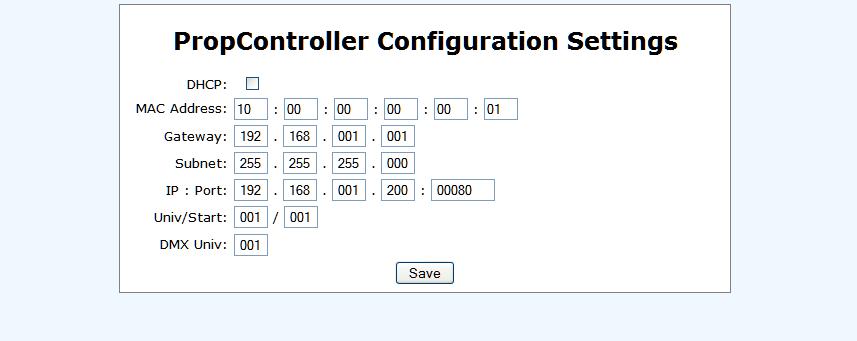

DynamoBen wrote:In the interests of showing off, here is a screen grab of the PropController's webserver. Nothing to exciting yet but it works. I need to do some error catching and more testing but so far so good.
Very nice, Ben.
\dmc

DynamoBen:
I was looking over your google source posting for the PropController and noticed that you implemented
•DMX / RDM (galvanically isolated RS485) or Ethernet (WIZNet W5100 module)
Curious: why the isolation for DMX/RS-485 (not that it's a bad idea)? Was it to re-use the design with the Ethernet-compliant RJ45 jacks with magnetics already on the board, or some other reason? During my research it did occur to me that in the case where ground loops are expected, an isolation transformer would be nice, and one could eliminate the ground line making it true 2-wire signaling.
I'm wondering if you were anticipating folks sharing (actually merging) the signal ground line with low-voltage, high-amp power supply, and thus the concern over ground differential?
ags0000 wrote:Curious: why the isolation for DMX/RS-485 (not that it's a bad idea)? Was it to re-use the design with the Ethernet-compliant RJ45 jacks with magnetics already on the board, or some other reason? During my research it did occur to me that in the case where ground loops are expected, an isolation transformer would be nice, and one could eliminate the ground line making it true 2-wire signaling.I'm wondering if you were anticipating folks sharing (actually merging) the signal ground line with low-voltage, high-amp power supply, and thus the concern over ground differential?
Actually this is a recommended practice for DMX. It is intended to protect the rest of the electronics on the board from damage when electrical spikes are introduced on the data cable. For example a lightning strike near by, over voltage, shorts, or anything else bad that could damage the expensive electronics.
If something bad does happen the damage is isolated to the optos and transceiver (typically just the transceiver). All that is needed to fix the problem is a chip swap, costing only a few dollars.
Update: I just finished the code for the Renard output driver. With this driver now you can use the PropController to control your existing Renard boards.
Also big thanks goes out to Greg (maker of Helix) he kindly gave me a copy of his code and I just had to make minor changes to make it PropController compatible.
I will post it to Google Project once testing is complete. BTW I don't have a Renard dimmer to test against so I'm just doing a protocol comparison.

DynamoBen wrote:Actually this is a recommended practice for DMX. It is intended to protect the rest of the electronics on the board from damage when electrical spikes are introduced on the data cable. For example a lightning strike near by, over voltage, shorts, or anything else bad that could damage the expensive electronics.If something bad does happen the damage is isolated to the optos and transceiver (typically just the transceiver). All that is needed to fix the problem is a chip swap, costing only a few dollars.
Also of note - Ethernet uses transformer coupling of the twisted pairs AFTER the PHY chip - this won't work for RS485, as the signals in question aren't DC-balanced.
It's usually done using optocouplers of the single-ended data going into/out of the RS-485 line driver/receiver chip, which is powered via an isolated power supply. (RPM's Enttec clone dongle is a great example of this design.)
DynamoBen wrote:Update: I just finished the code for the Renard output driver. With this driver now you can use the PropController to control your existing Renard boards.
I uploaded the code to the Google Project site. Enjoy.
DynamoBen:
Can't wait to try this out. Very exciting.
Separately: I've been meaning to ask what I'm guessing is a very simple question, and I think I know the basic answer - but not the precise answer.
With your E1.31 PropController (using the Wiznet Ethernet adapter for network connectivity), what would prevent it from working as a wireless client if connected using a wireless (gaming) adapter, such as this TRENDnet: http://www.newegg.com/Product/Product.aspx?Item=N82E16833156258 or NETGEAR: http://www.newegg.com/Product/Product.aspx?Item=N82E16833122373 ? Do the adapters simply require more native support from the host than is available with the WizNet & Propeller drivers? And (the real question) if so, exactly what is missing? I've looked at the PropController driver code for the WizNet and wonder what more would need to be provided. Heck, the WizNet's hardware stack supports TCP, UDP, ICMP, IGMP, ARP...
Just thinkin'... not necessarily something that I'll need to do, but it might be something fun to do - sometime.
I suppose for wireless connectivity an Xbee radio would be what most folks would use or suggest.
Al