

Has anyone ever heard of controlling a servo position as a pixel?
Example: I have a single servo that I want to wire inline in a pixel string. I want it to show up as a pixel. The various values of "dim" to that pixel will actually translate to various positions for the servo.
I am picturing a small board with a WS2811 chip on it and a plug for a servo.
Anything like this?
Matt Johnson
johnsonlightshow.com

Well, there are certainly DMX servo controls ... I just google'd "dmx servo controller" and got 29,000 hits.
The only problem I can see is whether the amps it would take to drive a servo would fry a WS2811 chip.
Get the specs for a servo and for the chip and compare them ...
\dmc

idleup wrote:Has anyone ever heard of controlling a servo position as a pixel?Example: I have a single servo that I want to wire inline in a pixel string. I want it to show up as a pixel. The various values of "dim" to that pixel will actually translate to various positions for the servo.
I am picturing a small board with a WS2811 chip on it and a plug for a servo.
Anything like this?
Matt Johnson
johnsonlightshow.com
Well, ... sound engineering requires you to know the signal requirements for the servo, the signal requirements for the pixels, the power requirements for the servo and the power requirements for the pixels. Now you can determine what it takes to merge the two devices.
My initial response is that the signals are not compatible. Then, as dmcole hinted at, the power supply requirements also need to be taken into account. You may experience noise from the servo motor when it is turning thus corrupting the pixel data stream.
Your concept can be done but it may require an intelligent interface, like a micro of some sort.

I think you would need a micro in place of(or in addition, depending on how you do it) to do the translation from 2811 to the servo signal. Servo's don't use the typical pwm signals that LED's do. As for powering, I would think you would need to supply power separately to the board to actually power the servo(s).

This actually sounds like a cool project. I haven't seen anything like this out there, but hypothetically speaking, wouldn't it be possible to design a board that acts like a pixel, and then converts its data to something that the servo could use? Yes you would need a micro to decode and rebroadcast the DMX stream, and you would need a power injection at that point so the servo would have enough juice, but it seems like something that people would pay a few dollars for.
If my above isn't too far off the mark (knowing me, it is though), I am surprised someone hasn't cobbled something like this together using some of the FOSS stuff out there (I am thinking a cross between a null pixel and a servo driver).

Why not just use a DMX stream directly? I'm not getting the value-add in interfacing as a pixel...

budude wrote:Why not just use a DMX stream directly? I'm not getting the value-add in interfacing as a pixel...
The only benefit I could see is if the servo is in the middle of or at the end of an existing string of pixels.
I think the complexity of doing the pixel data conversion would be much higher than running a dedicated DMX line. Matt, an output bank of your E682s can be dedicated to balanced DMX and you could then use any of the many DMX servo controller options already available.
budude wrote:Why not just use a DMX stream directly? I'm not getting the value-add in interfacing as a pixel...
I think he was expressing a concept without knowing what the details look like.
I interpreted that he has a pixel datastream using a WS2811 signal protocol. He then thought of tapping into this datastream using a WS2811 chip on a small pcb which in turn would drive a servo - somehow.
Well, many here know that he over-simplified the interface - hence your alternate suggestions.
In principle it can work if you have a micro to read the WS2811 datastream and then convert the specific channel byte to a servo output. Of course I'd start with an Arduino.... 🙂
Wow, lots of responses to my question!
I think it will help if I just explain what I want to do. I have these: 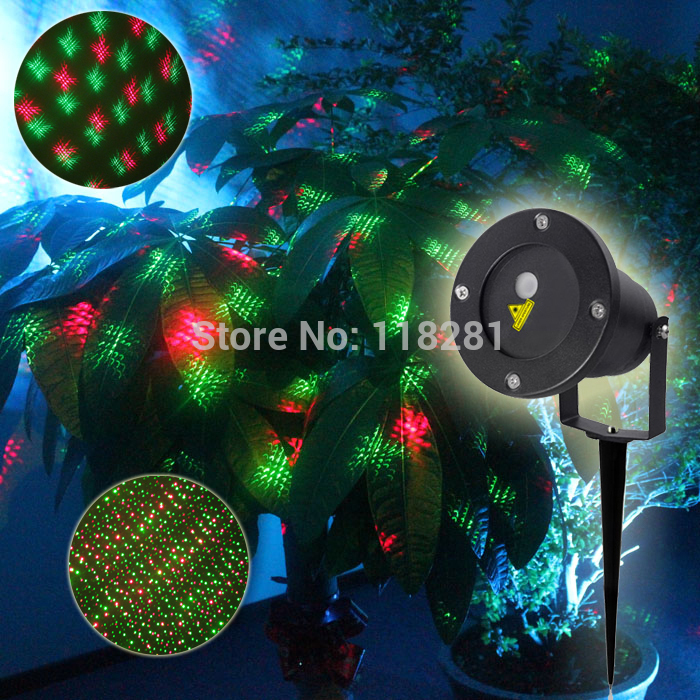
and I have these:
http://www.hobbyking.com/hobbyking/store/uh_viewItem.asp?idProduct=7562
by default, the laser projectors constantly rotate a diffraction grating that causes different patterns (I am sure you saw these over the Christmas season where it looked like a bunch of laser dots were moving or "snowing" as they were projected on someones house).
Anyway, my idea was to create a very small, very cheap circuit based on a WS2811 where channel "Red" for instance would turn on and off the laser while channel "Blue" sent positioning information to a servo using values 0-255 (or whatever the dim level values are on the output of the WS2811) that would represent 0-360 degrees on the servo (or whatever degrees of motion the servo is capable of) to control the rotation of the diffraction grating in front of the laser. Then I would throw the whole thing inside a landscape light housing and attach it inline to one of my existing pixel strings that are in the same areas where I want to place these units.
The reason I did not want to use DMX, is because I did not want to dedicate a whole output group of my e682 to DMX for one or two of these laser projectors as well as run dedicated control cables from the controller out to them in their respective parts of the yard. It would be MUCH easier to just treat each one as a pixel (I probably would only have a couple in my yard anyway). I would also then be able to control positioning (I would just know what effects are shown at each position) from within Vixen and can sync them to my sequence.
Anyway, that's the vision, you can see it would not make much sense to have a complex SBC or DMX servo controller for each light...
Matt Johnson
johnsonlightshow.com

Another possibility is to use analog techniques. Take an output of the WS2811 , low-pass filter it, and use the resulting output voltage to control the width of the servo control pulse. It's not going to be extremely precise, but what the heck.