

I purchased quite a few 50 LED Dome Lights from Home Depot. I am trying to see how easy it would be to use diodes to convert them to full wave. These sets have 2  cylinders on them. I am trying to figure out the purpose of these as well as if I need to do anything different when placing the diodes. I have attached a pic of the cylinder.

Sent from my iPhone using Tapatalk

That's called a "canister".
The "242" numbers mean 2.42K. They're in a 3x3 series/parallel arrangement giving 2.42K but with 3x the power handling capability. These are used for current limiting to protect the LED's on the string.
Home Accent light strings are usually full-wave, and that's why there are three wires running down the string. Half the LED's face one way, the rest face the other way, and they're wired in parallel.
So essentially, you have two half-strings in one string in a sense.
The way to make them full wave is to rewire one of the half-strings so that it's in parallel with the other half-string, and use a small bridge rectifier to feed all of them DC.
That changes the rating of the string though, because if it's a 3W string that's knowing that only half the LED's are lit at a time, so making it full wave will double the power draw because all the LEDs will be on at the same time thanks to the bridge rectifier.
Would I keep both canisters in place when wiring them in parallel?
frederic wrote:That's called a "canister".The "242" numbers mean 2.42K. They're in a 3x3 series/parallel arrangement giving 2.42K but with 3x the power handling capability. These are used for current limiting to protect the LED's on the string.
Home Accent light strings are usually full-wave, and that's why there are three wires running down the string. Half the LED's face one way, the rest face the other way, and they're wired in parallel.
So essentially, you have two half-strings in one string in a sense.
The way to make them full wave is to rewire one of the half-strings so that it's in parallel with the other half-string, and use a small bridge rectifier to feed all of them DC.
That changes the rating of the string though, because if it's a 3W string that's knowing that only half the LED's are lit at a time, so making it full wave will double the power draw because all the LEDs will be on at the same time thanks to the bridge rectifier.

rklarman wrote:Would I keep both canisters in place when wiring them in parallel?
You should only need to remove the canisters if you are shortening a strand.

You need to keep it on each section of light string in order to keep the leds running at at the proper current. If you shorten a string, the resistor "cylinder" needs to be changed (recalculated per number of leds and the forward voltage of each section) and if you change the original color mix also.
If you completely remove them and apply voltage to the string, you will fry every led "closed" (shorted). trust me, been there done that. After converting over 300 strands, one or two mistakes is unavoidable.
kmalsom wrote:You should only need to remove the canisters if you are shortening a strand.
2017 - Hmmmm...lots has changed...
Facebook: Stevensfamilylightshow
Youtube: Stevens Family Light Show
Web: http://www.stevenslightshow.com (under construction)

Cool, I've never seen a openable canister before! Always wondered what was in those. That sure is a neat way to increase current handling in a "small"(ish) form factor!

I bought several boxes of the 100 red, green, and blue sets before Xmas for my display. None of those had the caninster. Bought a few of the 100 clear ones after xmas and they had the canister on them. Did not know what is was but I do now! Btw, the colored ones dimmed just fine. I haven't tried the white ones yet but you might want to see how well they dim before converting them.
CaptKirk - Most of the cheapo home depot light strings have just resistors. Some of the more expensive strings may have diodes as well.
Rklarman - You should have two canisters on that string, one for each "leg" of LED's. Mine of the same brand do. Here is the before and after schematic of what I've done to some of mine:
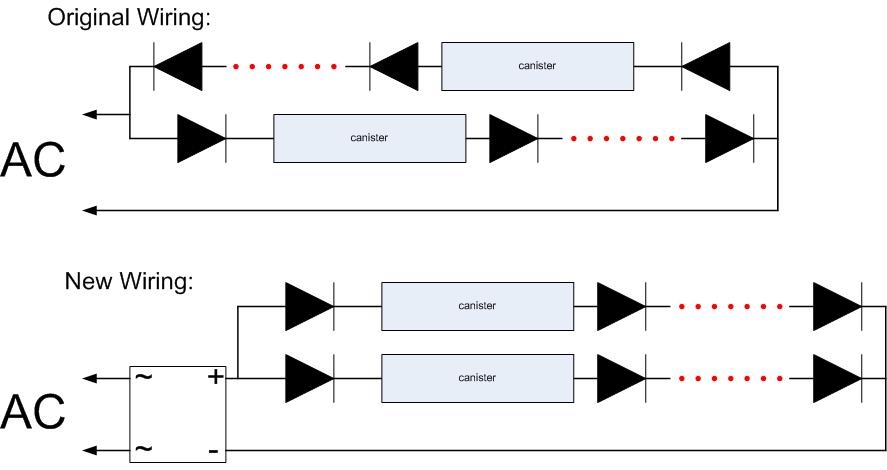
Since each canister still sees the same number of LED's, they still are sized appropriately.
Ah those without the "cylinder" in fact have the resistors on the legs of each led instead. I hate those when converting to individual colors because of this. Not all the colors n a solid color strand do this. Typically in multi color , the yellow and orange have the resistors on the LED leg. I now always buy only the strings with blobs/cylinders on the string. Easier to convert and rectifty. Unsoldering resistors of the led legs is for the birds. 🙂
howards9 wrote:I bought several boxes of the 100 red, green, and blue sets before Xmas for my display. None of those had the caninster. Bought a few of the 100 clear ones after xmas and they had the canister on them. Did not know what is was but I do now! Btw, the colored ones dimmed just fine. I haven't tried the white ones yet but you might want to see how well they dim before converting them.
2017 - Hmmmm...lots has changed...
Facebook: Stevensfamilylightshow
Youtube: Stevens Family Light Show
Web: http://www.stevenslightshow.com (under construction)
I rectify my strings also. However factory strings run at 10-12ma out the box. When you rectify the strings it pushes the current to 18-22ma through the leds, which is pushing the led limits and power rating of the "cylinders". They will get warm. I always reresistor mine, so when rectified, the currrent is back to 10-12ma. I am not to say that just putting the rectifier on a factory string is bad, but it will be in "overdrive" and could lead to premature failure
frederic wrote:CaptKirk - Most of the cheapo home depot light strings have just resistors. Some of the more expensive strings may have diodes as well.Rklarman - You should have two canisters on that string, one for each "leg" of LED's. Mine of the same brand do. Here is the before and after schematic of what I've done to some of mine:
Since each canister still sees the same number of LED's, they still are sized appropriately.
2017 - Hmmmm...lots has changed...
Facebook: Stevensfamilylightshow
Youtube: Stevens Family Light Show
Web: http://www.stevenslightshow.com (under construction)