

I'm new to DMX so maybe I'm missing something, so correct/educate me if I'm off the mark.
It appears to me that DMX has a fundamental timing flaw for our purposes. The timing flaw is in the fact that the DMX packet is constantly being repeated and not just sent when a change occurs or at the selected time interval.
This constant DMX packet repetition means that your event interval needs to be set to a multiple of the DMX packet time period. Currently the Enttec Pro plug-in sends out a complete packet of 512 values, so it takes the dongle approx. 23-25 msec to transmit the packet. The dongle won't send new data til the current packet is complete so it will only send out data at 23-25 msec intervals.
As an example, I set my event interval to 40 msec and ran a sequence with a basic alternating on/off pattern. What I end up with is on/off periods of either 25 or 50 msec.
This isn't a problem that can't be worked around but it is something that will need to made known to the future DMX users here.
What would really help is if we can get the Enttec Pro plug-in re-worked to allow for only sending the amount of channel data needed in the sequence. So lets say we have a 64 channel controller (won't use any names) hooked up, a DMX packet with 64 channels would be transmitted in approx 3 msec instead of 25 msec, so the amount of timing error due to a missed packet would be smaller. I know that someone (Ben?, RJ?) helped KC develop the plug-in so there should be some insight available on it here.
Even if the plug-in were to be changed it would still mean that anybody dreaming of a huge display would probably not be able to do small event intervals.
Any thoughts... (I'm sure I'm gonna hear a few :rolleyes:)

Right now I'm not sure that this is a big problem, and is probably the same thing as happening with mainstream Renard (and FG, for all that I know).
First, you are never going to get a 40 ms period with the current systems, because (except maybe for Lynx) power is applied/removed in synchrony with the power lines. So, in 60 Hz countries), you can get lights going on and off with a 25 ms period (1.5 AC cycles), 33.3 ms (2 AC cycles), and so forth (in principle). But there is also no guarantee that Vixen is sending data out at exactly 25 ms intervals, even if it's programmed to do so. There isn't any part of the system (Windows, .NET2, or Vixen) that has any real time attributes to it. There are always going to be things happening in the computer (no matter how fast it may be) that will delay scheduling Vixen activation well beyond any 25 ms timer tick, and certainly past an 8.3 ms tick.
Second, I forgot what second is, and have to get the post out before I get timed out by the forum.
--
Phil

P. Short wrote:Right now I'm not sure that this is a big problem, and is probably the same thing as happening with mainstream Renard (and FG, for all that I know).First, you are never going to get a 40 ms period with the current systems, because (except maybe for Lynx) power is applied/removed in synchrony with the power lines. So, in 60 Hz countries), you can get lights going on and off with a 25 ms period (1.5 AC cycles), 33.3 ms (2 AC cycles), and so forth (in principle). But there is also no guarantee that Vixen is sending data out at exactly 25 ms intervals, even if it's programmed to do so. There isn't any part of the system (Windows, .NET2, or Vixen) that has any real time attributes to it. There are always going to be things happening in the computer (no matter how fast it may be) that will delay scheduling Vixen activation well beyond any 25 ms timer tick, and certainly past an 8.3 ms tick.
Second, I forgot what second is, and have to get the post out before I get timed out by the forum.
--
Phil
Yes exactly, this is why everyone could not understand me talking about 25ms timing but I had my reasons for wanting to be able to handle it as I always do for most things. You will only have intervals of 25ms for timing with DMX but since at that speed you can flash a light or led faster than the human eye can see than 25 ms is as good as you would ever need. This is one of the reasons I recommended against the Open dongle as is it could not make 50 ms reliable on both computers in testing(including one that it work well on), so that puts you to 75ms which in some music is not fast enough. You are correct about Lynx in that it can change the brightness at the very moment it gets an update which is at worst 25ms from when vixen sends it out if thats the event timing.
This way you don't end up with maybe 25ms dmx and then it's just started another ac cycle so it's another 20ms before a change takes place etc. It can change the output in uS.
Not that this is an issue or makes it any more suitable for our needs.
Now the benifit to DMX comes in. you can not do in between times but you can run so fast at 512 channels it does not matter. The viewer can not preceive the error that in reality has been there all along do to as you say vixens timing, trying to update too many channels for the serial data rate, etc.
But with DMX you a assured of getting the 25ms no matter how many channels (512 max) because the protocol was designed to always send out 512 channels so the timing does not vary depending on how many channels you are running. I looked at making the plugin for vixen do trunucated DMX frames to help with speed on the open but realize that this was a mistake. as far as only sending out the channel data that updates this would total invalidate the DMX protocol and would be a mistake IMHO.
In the end as you pointed out we have never had 40 ms timing on the hardware. The 40 ms comes in on the interface side where setting you event to a even mutilple of the musics beat can make the seqencing easier. This just gets you as close as you can to the correct hardware timing for that beat of music and since our events times are so low the viewers can't see the 44ms miss of the beat we just had it's GOOD ENOUGH.
As alway I am sure I am total incorrect and will be striaghten out.
RJ

There are no future plans to update the Open DMX plug-in to allow for a truncated DMX packet (the DMX Pro can be truncated). While this might speed things up a bit its as I like to say "to much work for to little effect."
You have to remember that DMX is a protocol that has been around for 20 years. It’s used for every rock and theatrical show worldwide. Everything from moving lights to dimmers run from DMX and timing isn’t an issue.
With that being said there isn’t a lighting console that I’m aware of that handles timing the way vixen does. If you consider that a human eye blink takes 400ms and a movie frame is shown for 30ms (30 frames per second) you start to understand why such tight timing has little appeal. 😉
OK, I think I get it now.
At least this discussion has convinced me that I don't need to rack my brains out trying to create sequences under 50 msec or at odd intervals to match the beat exactly.
I guess I'm just too used to military electronics where you get exactly what you ask for. I guess I'll have to loosen up.:)
Now time to reformat my show computer.... step-daughter decided to surf the net with it and it doesn't have any spyware/virus protection and she downloaded a beauty.
Here is a scope shot that I took of the data coming out of my would-be USB_DMX converter. The firmware has been modified so that it only sends 64-byte DMX packets in order to make it possible to take the scope shot. Without this tweak you wouldn't be able to tell where one DMX packet ends and the next one begins.
The low-going pulses on the bottom trace shows the relative timing of the truncated DMX packets. As you can see, there is quite a bit of variation in the transmit intervals.
--
Phil
Edit...hold on a minute...the picture was too big.
--
Phil


Looks like every second packet was spot on 50msec, but the ones in between were about 5msec early. Probably not enough to be noticeable, but the difference is strange
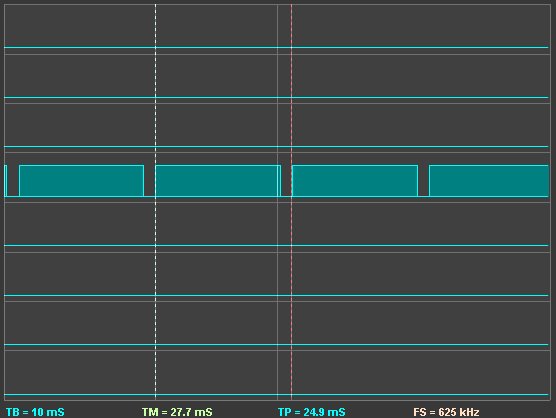
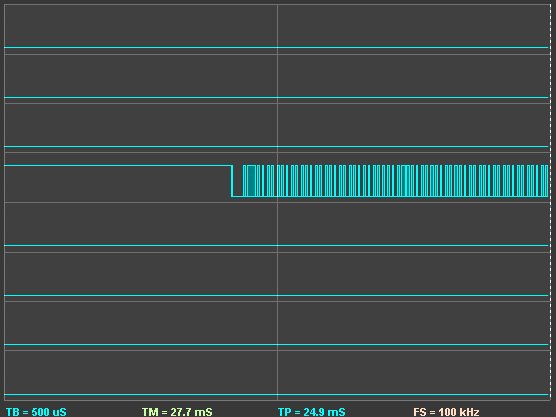
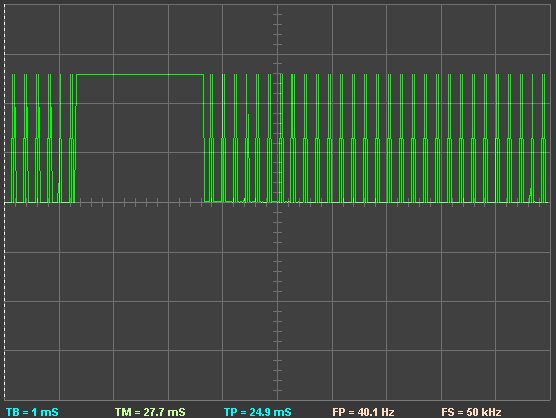
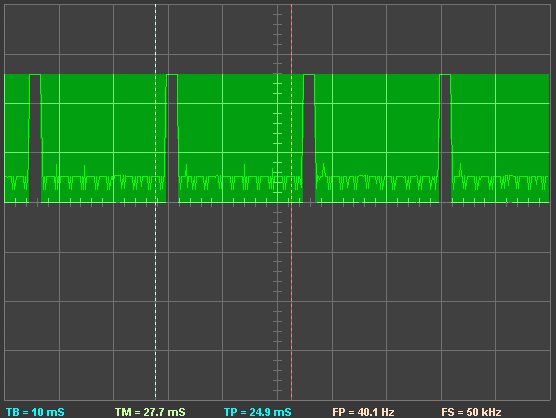
Phil, DMX doesn't normally vary like that. I attached a few scope shoots of some DMX for you. Maybe it will help you.
DMX1,DMX2 are form the logic analyser and dmx 3,4,5 are from the scope.
Dmx1 you can see that the frames are dead on at 25ms
Dmx2 lets you see the break and start of the frame with data following
The rest are just analog shot of the same in case you prefer that.
RJ


Actually, DMX can vary like that.
Section 5.0.6 from the 1990 standard says
"The time between any two frames of a data packet may vary between 0 uS and 1 Second. The line must remain in a 'marking' state during any idle period greater than 0 uS. A receiver must be capable of accepting a data packet having no idle time (o uSeconds) between any of its frames.
If you're building receiving gear, you shouldn't expect a fixed intra-packet time.
Yes the break can vary but unless I am looking at it wrong his data sections are varying. If that is OK great but nothing dmx I have looked at did that.
RJ