

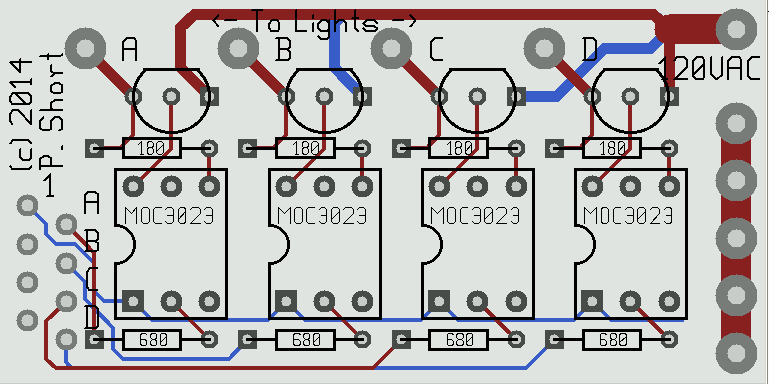
Here is an image of a little 4-channel SSR board that follows the concepts of the DirkCheap SSR board. The basic idea of both boards is minimalism. The cost of these boards is greatly reduced by taking the board down to its basics and by limiting the current carrying capabilities of the board. The terminal blocks, fuse holder and status LEDs are omitted, the large TO220 triacs are replaced with physically smaller, less expensive parts, and the RJ45 input connector is made optional.
The thing that somewhat bothers me about the board design using the VO2223a opto-triac part combined with a 680 ohm input resistor is that it is operating out of spec. The part is only guaranteed to trigger over all conditions with a 10mA input current. The 680 ohm resistor limits the current to about 5mA, around half of what is needed to meet spec. A lot of people say something to the effect 'well, it works fine for me, so what is your problem'? That's fine for others, but I do not like operating parts outside of specification. I've been burned too many times in the past with that approach, and I've ended spending too much time at inconvenient moments trying to fix either manufacturing or customer problems. Things works fine under ordinary conditions, but problems arise when the parts are operated at the edges of their environmental conditions (high/low temp, high/low voltage, etc) or as they age.
This board uses the MOC3023 opto-couplers that are prevalent on many of the other DIY boards, along with a smaller, less expensive triac. The costs from mouser seem to pencil out as similar at 100-piece quantities. The VO2223A costs $0.73 in today's pricing. The MOC3023 in the DIP-6 package from Liteon is $0.32 at today's prices, and the Z0110 in the TO92 package is also $0.32 at today's prices. So in 100's quantities from Mouser the prices are basically a wash, with the small advantage that the MOC parts are already in use on most of the other SSR designs and on the RenardSS boards. It's likely that these prices will vary somewhat from vendor to vendor, but they are very close.
This PCB design is 1.00" x 2.00", which is (I think) a little larger than the VO2223a design, so might cost a few cents more. The biggest advantage from my point of view is that the parts are being used within their specifications. Some may think that this is not a big deal (since the VO2223A boards seem to work), but it is to me.
At this point I've order 20 boards, which should arrive in a couple of weeks. This is the first time that I've used elecrow as a board fab vendor, so I don't have them calibrated yet.
By the way, I don't have a name for this board yet. The name on the jpg image is just a place-holder.

I too had looked at using the MOC3023 after I discovered it too was rated for 1 amp, and was much cheaper.
I like you tour approach.

I vaguely recall the discussions about using the VO part but I forget the reason for not using the MOC3023 directly since it's a TRIAC output as well. Was the current limit too small?
LightUp wrote:I too had looked at using the MOC3023 after I discovered it too was rated for 1 amp, and was much cheaper.
I like you tour approach.
About 7 or 8 years ago Ernie Horning did some investigation of that approach (although it was back in the days of incan mini's, rather than LED strings). His testing at that time showed that the parts worked fine, although it was against the manufacturers recommendations. I don't remember if those threads were at diyc or on the computerchristmas.com site.

I used elecrow for one of my recent group buys (RF_Color) and was extremely happy with them.
They did a great job routing an unusual board and the price could not be beat.
P. Short wrote:At this point I've order 20 boards, which should arrive in a couple of weeks. This is the first time that I've used elecrow as a board fab vendor, so I don't have them calibrated yet.

I like the idea of this design, especially after chasing ghost problems with a batch of dirk cheeps.

Phil. I defer to your expertise of course? But for those of us less experienced, why do you use an external triac if the moc has a triac output directly capable of 1A
I believe one of the reasons the 680 ohm resistors was used on the dirkcheap was to support the big pics like those used in the sr32 and rp32. Will your design work on those pics?
--Jon Chuchla--
Sent from my iPhone using Tapatalk

jchuchla wrote:I believe one of the reasons the 680 ohm resistors was used on the dirkcheap was to support the big pics like those used in the sr32 and rp32. Will your design work on those pics?
The Simple Renard 32 and the Renard Plus32 both use the 18F4520, which has a current max of 200ma, so it can only provide 6.25ma per output. The Ren 32 which uses the standard 16F688 can handle 10ma per output.
The MOC3023 is speced to trigger at 5ma per the spec sheet.
jchuchla wrote:Phil. I defer to your expertise of course? But for those of us less experienced, why do you use an external triac if the moc has a triac output directly capable of 1A
http://computerchristmas.com/ForumBoard/read.php?f=4&i=4202&t=4187
And some related threads...
http://computerchristmas.com/ForumBoard/read.php?f=4&i=4187&t=4187
http://computerchristmas.com/ForumBoard/read.php?f=4&i=4355&t=4355
http://computerchristmas.com/ForumBoard/read.php?f=4&i=4904&t=4904
So maybe you can use the MOC3023 by itself, and maybe not. I'm just being conservative.
I believe one of the reasons the 680 ohm resistors was used on the dirkcheap was to support the big pics like those used in the sr32 and rp32. Will your design work on those pics?
--Jon Chuchla--
Sent from my iPhone using Tapatalk
Phil,
How about calling it the: Ren Short-Stack