

mlkren wrote:I am 100% with oldcqr, don't worry about the number of feet for this and for that...
Just pick up one of the USB to RS485 that are recommend in this thread.
I agree as well - if someone is starting out then they should start right off with RS-485. Not only do you get longer distances but it's more immune to noise on the line as well. The price differential is not even worth talking about since this is the main artery for the whole shebang! Can/Does RS-232 work - yes - lots of folks using it, etc, etc but again - if I have nothing to start with, then I suggest starting with RS-485 from the get-go... $.02...

The standard has a clear answer, the maximum cable length is 50 feet, or the cable length equal to a capacitance of 2500 pF. The latter rule is often forgotten. This means that using a cable with low capacitance allows you to span longer distances without going beyond the limitations of the standard. If for example UTP CAT-5 cable is used with a typical capacitance of 17 pF/ft, the maximum allowed cable length is 147 feet.
If this hobby is a passing fad and you won’t be doing this for more than a couple of years then go with the RS232 that you already have. If you intend to continue for many years then why not just go with RS485 right away and eliminate a potential problem. All of the newer controllers communicate this way because of the benefits and minimal cost. I went with RS485 my first year (5 years ago) and never looked back.

michaelc wrote:also, unless you are using an older computer, the new ones don't even have a DB9 port anymore other than the monitor out. It's all USB
erm213 wrote:VGA monitor out is DB15, not DB9. They do look similar.Erik
michaelc wrote:my bad, then there really isn't anything that even resembles a DB9 or DB15 left on most newer computers.
Actually, there is no such connector as a DB-9 OR a DB-15.:shock: 😯 😯 The first character ("D") refers to the shape of the shell. The second character refers to the physical size of the connector - thus the DB-25 connector is a size "B" D-shaped shell, with 25 pins.
The small connector commonly used for serial ports is a size "E", thus the connector is a DE-9 connector. However, the common VGA connector, although it is a size "E" shell, is a "high-density" connector with three rows of pins (usually labeled "HD-DE-15").
Just a little information rapidly approaching uselessness (like most of what I know), due to technological upgrades.
🙂

wiretap, you never know. There might be a career there. Maybe this organization needs a historian: http://www.ce.org/Events/Awards/348.asp
Michael

New for 2016: Getting my ESPixel network to function, 4 HDPE Pixel Arches, Pixel matrix on tree trunks. PIXELS!!!FACEBOOK: https://www.facebook.com/GothambeatProductions?fref=ts
Gotham Beat Productions LLC
WireWrap wrote:Just a little information rapidly approaching uselessness...
It's one of the side benefits of being old. Unfortunately, it seems to be easier to recall the useless stuff and my wife is well aware of this fact.

First, I do agree with using RS-485, buy the converter because you will save yourself some issues later.
Sorry to hijack and throw a wrench into the discussion but maybe we should discuss it...
Does anyone think that using the usb to Rs-485 can cause more problems with port errors as opposed to using a standard serial to Rs-485 converter.
Maybe buying a PCI serial card and a converter if you don't have a serial port.
Also for the newbie, the documentation on what wires to connect to your RS-485 is lacking, I know I struggled to figure out the correct wires to use and was frustrated getting it to work correctly.
Can we make a more concise explanation to ease the learning curve?

bcstuff wrote:Also for the newbie, the documentation on what wires to connect to your RS-485 is lacking, I know I struggled to figure out the correct wires to use and was frustrated getting it to work correctly.
Can we make a more concise explanation to ease the learning curve?
I'm a bit surprized this is an issue. There are plenty of diagrams available here on DIYC and in the Wiki for RS485. There are only 3 connections: RS485+, RS485- and GND. These are very clearly explained (for Renard, anyway) as to the pins on an RJ45 connector they are assigned.
bcstuff wrote:Does anyone think that using the usb to Rs-485 can cause more problems with port errors as opposed to using a standard serial to Rs-485 converter.
There's really no difference other than USB has more intelligence in the protocol, it's still serial at a much higher baud rate and it at CMOS voltages instead of RS232.
bcstuff wrote:Also for the newbie, the documentation on what wires to connect to your RS-485 is lacking, I know I struggled to figure out the correct wires to use and was frustrated getting it to work correctly.
It wasn't the easiest to find but it was in the Wiki. I found it buried the 'The Renard SS24 Controller Board' section though it probably should be in separate connection section and referenced to, from all controllers.
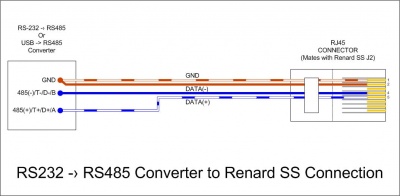
Edit: We know that the Wiki needs work, it eventualy will get fixed. Use the search fucntion to the left in the Wiki to help you.
Dirk, I originally had difficulty finding the information but eventually got it worked out. It didn't help I had a bad RJ45 jack connection messing up my communication either though.
I am not trying to say the information is not available, just not as clear as the picture that Ernie posted above. I found the information on what connections to make in a random post because what I had found originally in the WIKI wasn't clear.
I do realize there have been updates to the WIKI that have improved it, I was speaking of what happened to me in the past. I was able to find the image that Ernie posted above, but it wasn't readily easy to find as Ernie stated. I did also find some other pin out diagrams in the WIKI along with some pictures. This seems to be improved from when I first started, but could be because I now have more experience with DIYC.
I always try to take an outside look at things.
Try and find information as a person with little experience with computer controlled Christmas. See how easy it is to find information when you are not familiar with our terminology.
My goal is not to point fingers or say that things stink, I only wish to improve DIYC so others can share in the joy that this hobby and this site have provided me.
Also by bringing up this discussion it helps to point the OP and future searchers where to find the information they will need to go to the next step when they are ready.
Ernie, I wish I would have found that picture when i was trying to get everything connected. It is very clear and concise.
On the subject of the USB RS-485 converter, I had suspected when I first started having COM port errors that it may have been related to my USB to RS-232 connection. I did receive less COM port errors after switching to a PCI serial card then into my RS-232 to RS-485 converter, but it could have been from other measures I had taken to prevent the problem.
Brian

bcstuff wrote:Does anyone think that using the usb to Rs-485 can cause more problems with port errors as opposed to using a standard serial to Rs-485 converter.
I am going to answer that with a 'most likely YES'. I can't say that I have used USB to RS485 adapters with Vixen, but I have used USB to RS232 (and then to 485) and had a lot of port problems. I'm pretty sure that a USB to 485 is going to present it self to the OS a lot like a USB to 232 - IE, an emulated USB communications port.
2 years ago when I used the USB to 232, Vixen would randomly crash while running the display with 'Unable to open port' errors. This past year I switched to 'real' (IE PCI card based) ports and the problem went completely away. Others have had similar experiences.
IMHO, you are better off buying a card to make 'real' ports, and then converting to RS485 from there.