

when designing a circuit, how do you decide what resister value you would need? for example, if you're looking to have two chips on a pcb, how do you determine if you need a resister between them and what value to use? can someone recommend a good site on beginning circuit design?
thanks!

Hi Mark,
While I don't or haven't design any circuits. The first place to look would be the data sheets for each chip. Go to the manufacture of the chip and look at the pdf for the chip you want to use. I think they also include some basic ways to use their stuff and basic circuits for it.
or I am completely wrong and somebody will correct my statements.
Have fun
Rick R.
no, you're right there. i've looked at data sheets for some chips. some manufacturers give simple schematics on how to use their chips, but not all of them.
thanks
Hi Mark,
I did a quick google search for hobby schematics PIC and this site was one of the choices:
http://ourworld.compuserve.com/homepages/Bill_Bowden/homepage.htm#menu
There are a ton of sites that offer info on circuits and schematics.
Have fun
Rick R.

It all depends on the application. If you're just getting into electronics, you may want to check your library or bookstore for a book on electronics. They will explain the necessary math to calculate the resistor values.
-Matt
i'm basically looking to learn to design circuits for some ideas to use next year (or the year after) and am looking for a starting point.
thanks for everyone's input!

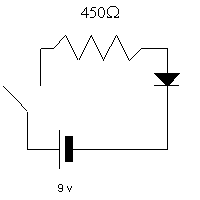
Heres a simple problem to start with...
Take a standard low power 5mm LED, a 9V battery, a switch and a resistor... I want 20mA to flow through the LED, when the switch is turned on...
(a) draw a circuit that you think might work..
(b) calculate what the value of the resistor needs to be
mrpackethead wrote:Heres a simple problem to start with...Take a standard low power 5mm LED, a 9V battery, a switch and a resistor... I want 20mA to flow through the LED, when the switch is turned on...
(a) draw a circuit that you think might work..
(b) calculate what the value of the resistor needs to be
how's this:

I would suggest getting yourself a breadboard and do some experimenting. Maybe even try some simple kits. There are lots of good hobby kits available. Many of them might not be something that's all that useful, but you can learn a lot that way. Some of the better kits actually come with a description of how the circuit works.
I am by no means an expert in electronics, but I think that I have a pretty good working knowledge of things, even though I have had very little formal training. I learned most of what know from experimenting, building kits, and reading every book and magazine on the subject that I could get my hands on. I think that I was Heathkit's number one customer in the 70's and 80's. I still have a complete set of Radio Electronics magazines from 1976-1992. I used to love that magazine, too bad it's no longer published :sad:. These days the information is even easier to come by with the Internet.

Heathkit!!, I'm glad I'm not the only one who remembers them! LOL
Jack