

One of the things I thought was a PITA was the need to stab in power along the RGB pixels. I have a bunch of C7 style screw in LED bulbs & was wondering, why dont they make a 110/120v screw in / plug in pixel bulb that uses 110/120 volts that you can change the color like the 5 & 12v Pixels. This way you could easily replace the LED if it goes bad, has plenty of power, no need to stab in power, can be easily cut/spliced to fit where needed. Seems like a win/win to me.......?

Regardless of the input voltage, I believe most all LED's run at 5VDC or less. So what appears to be an AC powered LED light, is actually a 5VDC LED with circuitry changing the voltage from 110VAC to 5VDC. Even the 12VDC pixels actually run at 5VDC, they just have voltage reducing circuitry or a resistor to reduce the voltage to 5VDC. The benefit of 12VDC for your mainline voltage is that you can push it further without power injection, then just reduce the voltage to 5VDC at the LED. Could there be a voltage changing circuit to change 110VAC to 5VDC at every light? I suppose there could be, but I bet it would either be price or space prohibitive. I like your way of thinking, but I am afraid we will be power stabbing long into the future.

There actually have been some. There was a product sold at walmart several years ago that worked by having something on the order of 25 bulbs in series thereby reducing the voltage per bulb down to around 5V. This is the same concept of AC LED string lights. I forget how the data scheme worked on those. Though I remember it was an unconventional setup and not particularly fast or reliable.
So my guess as to why we don't see more of that, is that it didn't perform well enough, or was reliable enough. And to make it performant and reliable would be too costly to be practical.
jchuchla wrote:There actually have been some. There was a product sold at walmart several years ago that worked by having something on the order of 25 bulbs in series thereby reducing the voltage per bulb down to around 5V. This is the same concept of AC LED string lights. I forget how the data scheme worked on those. Though I remember it was an unconventional setup and not particularly fast or reliable.So my guess as to why we don't see more of that, is that it didn't perform well enough, or was reliable enough. And to make it performant and reliable would be too costly to be practical.
All of the LED string lights you get at the big box stores are like that, & they are JUNK. It has some type of power reducer & then a bunch of LEDs in series to lower power even more. Basically wired like the miniature filament light strings. I bought a bunch of those from Walmart (Walmart brand, get what you pay for), around 6 or 7 years ago. The next season about 80% of them did not work. I took ALL of them back. Junk.
What I am thinking of is something like the LED bulbs pictured below. These are traditional C7 size & screw into a regular C7 incandescent string, 110v at each bulb. There is some type of power reducer circuit in it to get down to 5v. But you can run the string a long distance & no need to inject power into it. there is 110v at each bulb because they are ran in parallel.
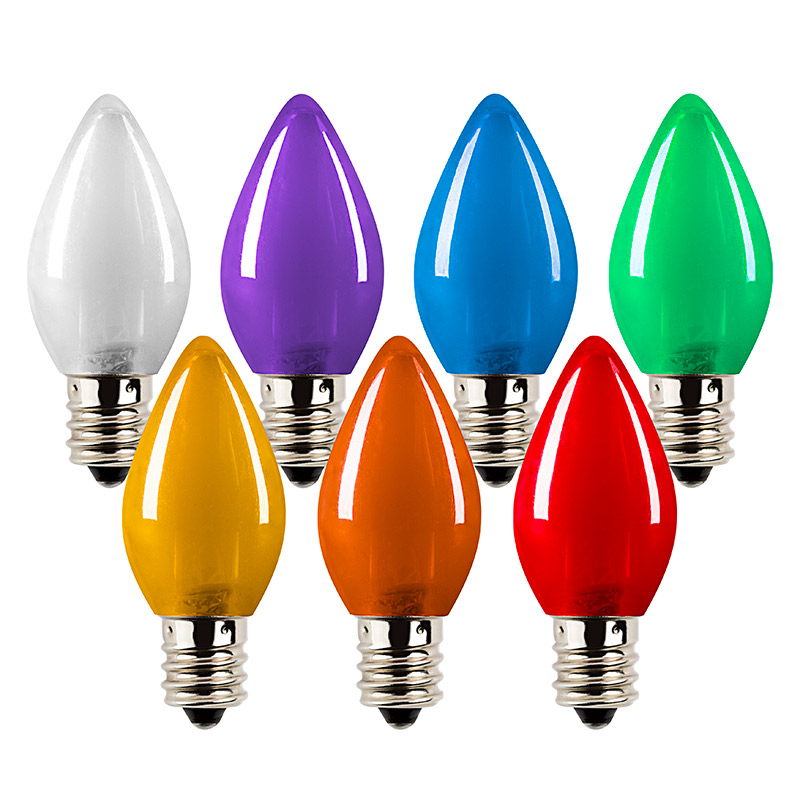
Could do one with the RGB LED, change the socket design to include the data circuit & be able to wire your house from one power source.
MikeKrebs wrote:Hi samckitt, let's do some forensic work. Take one of your bulbs and dissect it - keeping all the parts intact as much as possible. After you find the power part, solder on a 5v pixel and run a data/ground to a controller and see if you can make it work right (might want to skip the data/ground to controller part for testing). I am thinking it would take a 4 wire harness to do the lights but you might be onto something. If the data line could somehow be vampired with a cut so the data can be in and out, it could be a very cool system.
I might do that. Yeah dont know how the data circuit would work. With DC it uses the ground (-) & the data wire. may need 4 wires like you say, or maybe some regular diodes on the data circuit to control current direction. Don't know. The electrical engineers need to figure that out, LOL.

samckitt wrote:I might do that. Yeah dont know how the data circuit would work. With DC it uses the ground (-) & the data wire. may need 4 wires like you say, or maybe some regular diodes on the data circuit to control current direction. Don't know. The electrical engineers need to figure that out, LOL.
I can be completely wrong but can't the higher voltage mess with the data lines due to it being AC?

sounds like a very expensive "replacement" bulb
samckitt wrote:All of the LED string lights you get at the big box stores are like that, & they are JUNK. It has some type of power reducer & then a bunch of LEDs in series to lower power even more. Basically wired like the miniature filament light strings. I bought a bunch of those from Walmart (Walmart brand, get what you pay for), around 6 or 7 years ago. The next season about 80% of them did not work. I took ALL of them back. Junk.Could do one with the RGB LED, change the socket design to include the data circuit & be able to wire your house from one power source.
The ones i quoted weren't the typical big box store ones. Well, they were quality wise, but they were individually addressable like a pixel. If you search on here you should find the thread. I think we called them WM2999 pixels. (As in $29.99 at WalMart)
The problem with a screw base bulb is that it needs to be 4 pin connection. And two of those pins are low voltage, that's hard to do in such close proximity with 2 pins being line voltage and 2 pins being low voltage. In theory, It could be a 3 pin connection using a data bus rather than a daisy chain, but then every bulb would need to be given an address at least once when it becomes part of the string.