Ethernet cable Cat 6 or Cat 6A

I know. Monoprice is a bit more expensive. However, I feel the quality of the product is worth the price differential.

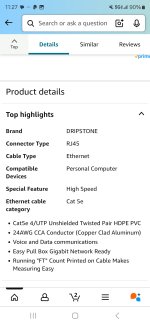
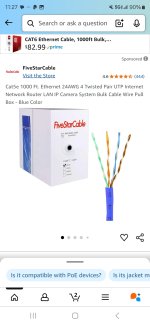
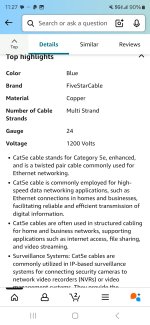
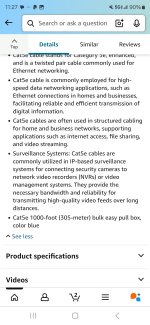
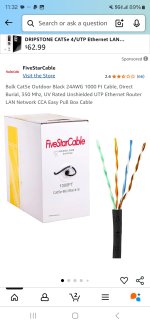
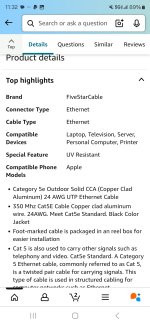
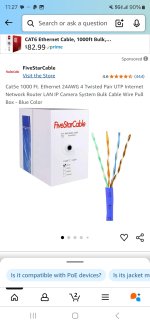
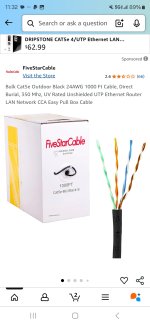
OMG I feel like this should be this difficult for me but it is. I'm trying to find Cat 5e stranded on Amazon. None of their cables say stranded. I have found ones that say outdoor, standard or nothing really. Here are some pictures. Please let me know which one I need to get and again I apologize.Screenshot_20250321_112714_Amazon Shopping.jpgScreenshot_20250321_112730_Amazon Shopping.jpgScreenshot_20250321_112740_Amazon Shopping.jpgScreenshot_20250321_112753_Amazon Shopping.jpgScreenshot_20250321_112758_Amazon Shopping.jpgScreenshot_20250321_113208_Amazon Shopping.jpgScreenshot_20250321_113221_Amazon Shopping.jpg
 
I Personally would not buy the CCA wire. All my Cat 5 is 24 awg stranded copper.
It's been years since I bought from Monoprice, but they do put stuff on sale, if your
not in a big hurry, just watch for a while.
 
Where do you all get your cat cable from. I'm looking for the best deals for 500 to 200ft. Man this hobby is expensive
This hobby can be quite expensive. While pre-fabricated, shielded, stranded Cat6 cables have their advantages, a box of Cat5, a pack of RJ45 connectors, and a crimping tool can still get the job done for my display. Every setup is different. In my case, props are driven by central controllers using SSRs and long-range receivers, requiring numerous Cat5 runs. Having worked on and installed WAN/LAN networks for over 30 years—since before the internet was “cool”—building network cables is a simple task for me.

In your scenario, with four controllers and pixels directly connected, you only need 4–6 Ethernet cables to link the controllers to your home network. (Note: The Falcon has daisy-chain capability, eliminating one cable.) With so few connections, pre-fabricated cables make sense. Take a moment to measure the actual distance required—200 to 500 feet sounds excessive. My longest cable run, from the home router to the show switch, is under 150 feet, and you may find your setup requires less than 200 feet.

You also previously asked (in the "I need all the help I can get" thread) about installing a network switch (Cat5 splitter). With four controllers, you'll need to connect them either to a central "show" switch or run separate cables to the home router. My show switch is housed in a CG500 case near the front porch, allowing all my controllers to connect there, significantly shortening my cable runs. You could do something similar by placing your show switch centrally and running a single long Ethernet cable to the home router, minimizing the length of individual controller runs.

From a cost perspective, I agree—this hobby can be very expensive. Many of us have built our displays gradually, adding one or two props annually. Even when I transitioned from AC lights to pixels, I still only added a couple of props at a time. In total, I’ve spent under $15,000 on this hobby, but spread over 18 years, that’s less than $70 per month—far easier to manage than dropping $15K all at once.

I appreciate your military service—something only about 7% of Americans do. I’m also a veteran, retired Army, and we all know that ARMY = "Ain’t Ready for Marines Yet," but at least we understand that crayons have uses beyond eating! Jokes aside, think back to your military training and the “crawl, walk, run” approach. Sure, it was slow, tedious, and sometimes sucked, but you had to master the basics before jumping into the advanced stuff.

The past couple of weeks have mainly focused on connecting and powering the controllers—which is important—but that still leaves the other 997 things to plan and execute. Consider mechanical attachments to the house, FM transmission, and designing a garage door matrix that still allows the door to open. These are all critical parts of the bigger picture.

I’m not trying to discourage you—I admire your enthusiasm and, honestly, I see a bit of myself years ago. I just want to make sure you’re setting yourself up for long-term success. Based on some of the questions you’re asking and my own experience, it seems like you’re jumping straight into the "run" phase without taking time to crawl or walk first. Taking on 39,000 pixels all at once is certainly possible, but is it the best approach? There’s a lot to learn, and diving in too fast can lead to frustration or costly mistakes. I’d hate to see you get burned out before you really get to enjoy it.
 
I eliminated 99.9% of my cat5 in 2009 when I went completely wireless. I still have a crimper though, and hundreds of cat5 plugs in case I run into trouble with the two cat5 cables I have that go to my outdoor AP's.

And I still have some hair left...
 
girldadxmas - are you past the point (timewise, mindset or purchase-wise) of going wireless? There are a lot of advantages of going wireless, especially if the pixel data is stored on the controllers rather than being streamed over the air.
 
Last edited:
As stated in another thread, He plans to use Cat5 from controller to prop. I know people do it,
I did for a few years but have since done away with all cat5 wire used for power. It's not worth
the trouble.
We share what we do, How we do it. I'm not going to "Tell" someone What to Buy, or How to do it.
 
Maybe only Data and ground from controller not power. That was a assumption
on my part, sorry.
 
I eliminated 99.9% of my cat5 in 2009 when I went completely wireless. I still have a crimper though, and hundreds of cat5 plugs in case I run into trouble with the two cat5 cables I have that go to my outdoor AP's.

And I still have some hair left...
I never quite moved beyond the "crawl" phase with wireless. While it was exciting and taught me a lot, I’ve always favored cables whenever possible. My first job in the military was PBX switching, which quickly transitioned into data, and I guess I became hooked on the reliability and simplicity that cables offer.

As for using Cat5 for power, I now limit it to my RGB, DMX-controlled setups—not for pixel power injection. Since I use Long Range Receivers, I can place power directly at the prop. That said, as @rayhjr pointed out, using Cat5 strictly for data transmission is a solid approach. The only drawback is the possible need for null pixels to regenerate the signal at intervals.
 
Tony, I'll certainly agree with you and everyone else that wired is more secure than wireless.

For me, the turning point was when I was trying to repair a cat5 cable outside in the snow and -30F temps after tree rats had gnawed on it. In those temps, cat5 doesn't bend; it breaks, as do the plastic connectors. That was at a time when I was already experimenting with wireless to get to props on the other side of my yard, across a driveway, and it was working well enough that the next week, I unplugged the cat5 and replaced everything with wireless.

The tree rats had a field day with all the cat5 after that and I didn't care.
 
I do believe that Dan Kulp said he designed a wireless controller because he was color blind and could not clearly see the colors on cat5 wire.
 
I run a mix. I do have some remote props that are wireless and that works well. I have an area in my yard that has a short distance between controllers so I use CAT6 in those areas. FYI: I use AC Line ethernet to go from inside the house to the outside. The master is outside and accessing the web UIs on the controllers over the AC line works very nicely.
 
I get my cables on Ali, and at that price point what I do if I have questions like these is get 30 meters of each and see if I notice a difference in practice. For me in practice, it's not the type of cable causing all the problems; it's the connectors. The crimp can come loose, the lip will.break, water will seep in and corrode the leads, temperature swings will loosen the connections. I might care a little about the exact type of cat cable if it is carrying literal 2.4GHz signal, but almost always the problems are going on at the ends--not the middle.
 
RE Water in the connector. All of my cat5 connectors get a few drops of corrosion-x gun oil prior to insertion (even the ones doing real Ethernet). I have not had a connector fail due to a corrosion issue. Broken tabs / boots, tree rats are another story.
 
Back
Top